The Story of Six Mile – A Timeline
Timeline Modal Title
Sources: V. Mitchell 2002 / Grant, Richardson and Griffin 1999 / Stewart Robertson 1985 / Gorham Mitchell 1989 / Lyle 1990
Cherokee Path
Placement of the Cherokee Path marker in 2018 highlighted the importance of the trade route in the early history of South Carolina. You can view the marker in front of Town Hall on Main Street in Six Mile.
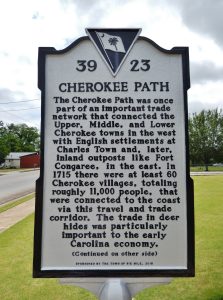
(side 1 • faces north •
Town Hall right of marker)
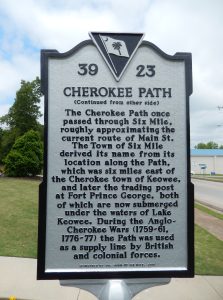
(side 2 • faces south •
Town Hall left of marker)
Marker Number 39-23 Inscription
The Cherokee Path was once part of an important trade network that connected the Upper, Middle, and Lower Cherokee towns in the west with English settlements at Charles Town and, later, inland outposts like Fort Congaree, in the east. In 1715 there were at least 60 Cherokee villages, totaling roughly 11,000 people, that were connected to the coast via this travel and trade corridor. The trade in deer hides was particularly important to the early Carolina economy.
The Cherokee Path once passed through Six Mile, roughly approximating the current route of Main St. The Town of Six Mile derived its name from its location along the Path, which was six miles east of the Cherokee town of Keowee, and later the trading post at Fort Prince George, both of which are now submerged under the waters of Lake Keowee. During the Anglo-Cherokee Wars (1759-61, 1776-77) the Path was used as a supply line by British and colonial forces.
Photography by Cosmos Mariner, May 7, 2019
The Legend of Issaqueena
According to the legend in the years before the revolutionary war Cateechee lssaqueena, a Creek Indian maiden, fell in love with a trader named Allen Francis. Some versions of the legend say he was a silversmith named David Francis. Regardless, it was a colonial Romeo and Juliet disapproved of by many.
The conflict between cultures eventually led to a planned attack on the settlers. Learning of the impending massacre by her tribe lssaqueena mounted her horse to warn them.
On her ride, she mentally named the landmarks she passed along the way: Mile Creek, Six Mile, Twelve Mile, Eighteen Mile, Three and Twenty, Six and Twenty, and finally Ninety Six. The towns of Six Mile and Ninety Six and the creeks bearing these names continue to exist. It is actually 92 miles from her starting point to Ninety Six, so she was pretty close. She arrived in time and the settlers were ready when the Indians arrived.
Issaqueena and Francis were married and lived for a while at Ninety Six. Hearing that the Indians were determined to capture them they fled to what is now Stumphouse Mountain north of Walhalla to escape the fury of her betrayed tribe. They lived in a large, hollowed-out tree or Stumphouse. According to some historians, the Stumphouse was actually a house built on top of a stump. But that is another story…
During an attack by the Indians Issaqueena fled carrying her baby on her back towards the falls. She poised at the edge and then gave one mighty leap over the falls. Thinking her dead, her pursuers gave up the chase and returned to their homes. But lssaqueena had landed on a ledge and was safe. The falls, also located in Walhalla, were named Issaqueena in her honor. Issaqueena later joined her husband and they went to her people, the Creeds, in Alabama.
Issaqueena Falls has a similar story as Connestee Falls which is located south of Brevard, NC. In each case, the falls are named after an Indian maiden who allegedly jumped from the falls out of love for a white man. Whereas Connestee jumped to her death, the Issaqueena legend has a happier ending.
A Proud Legacy of Service
Six Mile holds a remarkable distinction: At one time, Pickens County was home to more Congressional Medal of Honor winners than any county in the Nation (there were only 27 in the whole country), and three of these four men were from Six Mile.
The Medal of Honor is the highest award for valor in action against an enemy force which can be bestowed upon an individual serving in the Armed Services of the United States.
Medal of Honor Recipients
Charles Heyward Barker (April 12, 1935 – June 4, 1953) was a United States Army soldier in the Korean War who received the U.S. military’s highest decoration, the Medal of Honor.
James Donnie Howe (December 17, 1948-May 6, 1970) was a United States Marine who posthumously received the Medal of Honor for his heroic actions in May 1970 during the Vietnam War.
William A. McWhorter (December 7, 1918 – December 5, 1944) was a United States Army soldier and a recipient of the United States military’s highest decoration—the Medal of Honor—for his actions in World War II.
Furman L. Smith (May 11, 1925 – May 31, 1944) was a United States Army soldier and a recipient of the United States military’s highest decoration—the Medal of Honor—for his actions in World War II.
(Submitted on May 8, 2012, by Brian Scott of Anderson, South Carolina.)
Six Mile Veterans Monument
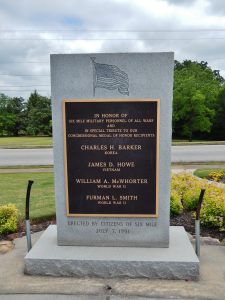
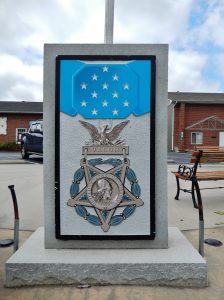
Monument Inscription
In Honor Of Six Mile Military Personnel of All Wars and In Special Tribute to Our Congressional Medal of Honor Recipients:
Charles H. Barker Korea
James D. Howe Vietnam
William A. McWhorter World War II
Furman L. Smith World War II
(Erected in front of Six Mile Town Hall by citizens of Six Mile on July 7, 1991. )
Photography by Brian Scott, May 7, 2012.